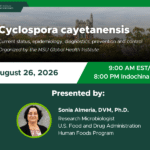
The Michigan State University Global Health Institute will host a free online webinar on August 26 examining the current state of research into Cyclospora cayetanensis, a microscopic parasite that causes the foodborne illness cyclosporiasis in the United States and around the world.
The session, titled “Current status of Cyclospora cayetanensis: epidemiology, diagnostics, prevention and control,” will run from 9 to 10 a.m. Eastern time via Zoom. It is free to attend and open to the public through registration on the Global Health Institute’s website.
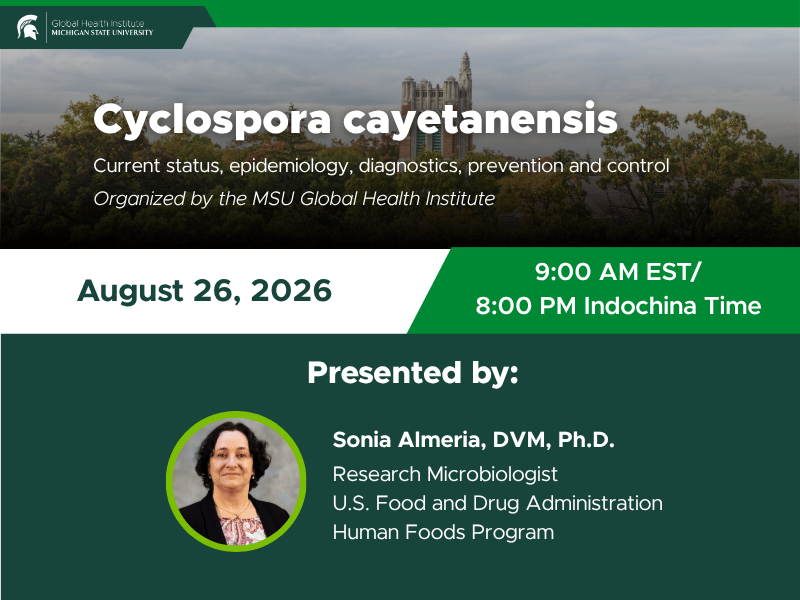
The featured speaker, Dr. Sonia Almeria, is a research microbiologist with the U.S. Food and Drug Administration who has spent more than three decades studying parasitology and epidemiology. She holds a Doctor of Veterinary Medicine degree and a Ph.D. in parasitology, and she has authored or co-authored more than 150 published works over the course of her career.
Since 2016, Almeria has directed federally funded research focused on developing and validating methods to detect and characterize Cyclospora cayetanensis in fresh produce and soil, work that sits at the intersection of food safety and public health. She also wrote the FDA’s chapter on foodborne parasites and currently leads international standards working groups addressing the parasite through the International Organization for Standardization.
Cyclospora cayetanensis is a single-celled parasite that spreads primarily through contaminated food and water, and it has been linked in the U.S. to outbreaks tied to imported and domestically grown fresh produce, including herbs, leafy greens and berries. Infections can cause prolonged watery diarrhea and gastrointestinal distress, and outbreaks tend to cluster in the summer months, making the parasite a recurring concern for public health officials and the food industry alike.
In her presentation, Almeria is expected to walk attendees through the parasite’s biology and how it spreads, along with its clinical presentation in infected patients. She will also address the diagnostic and detection methods currently used to identify the parasite in both clinical samples and food products, along with available treatment options. The talk will conclude with a look at prevention and control strategies, as well as the research priorities that Almeria and other scientists in the field see as most pressing going forward.
The webinar is part of the Global Health Institute’s ongoing series of events connecting MSU audiences with researchers and practitioners working on pressing global health challenges.